
AMD Umbra pairs MI355X with IBM Nighthawk
A new quantum-classical computing platform aims to reduce error correction latency and help researchers reach 100 logical qubits and 100,000 operations by 2028.
 Hakkı ALKAN
Published 6 min read
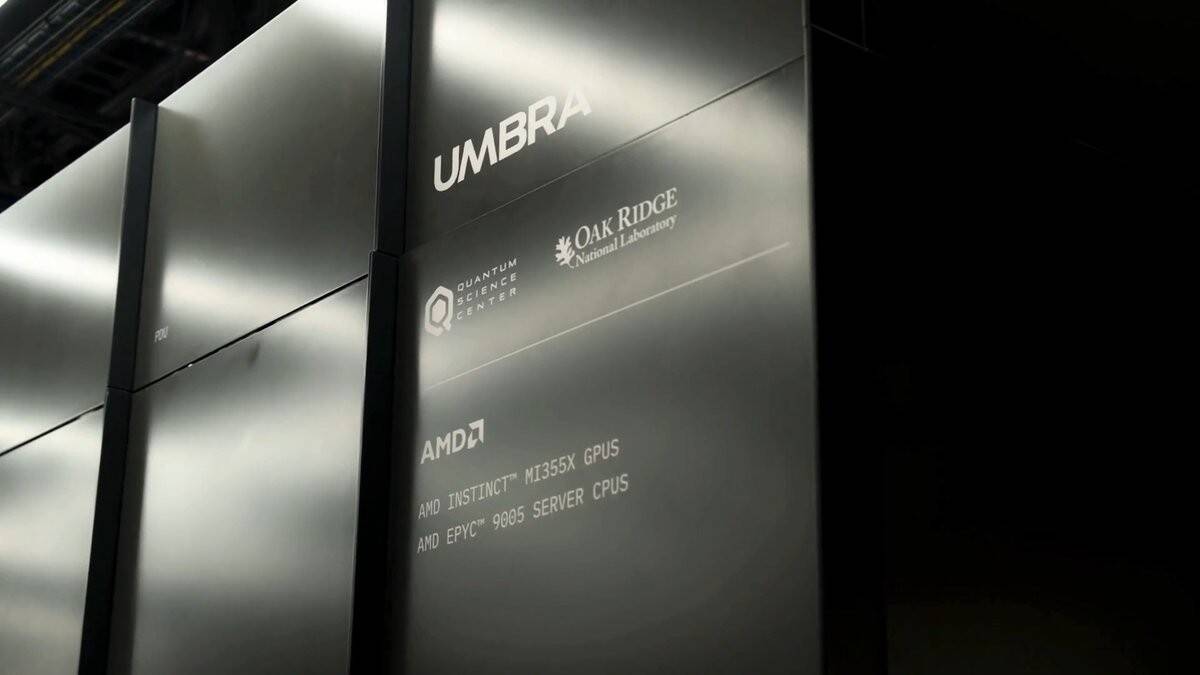
According to AMD's November 5, 2026 announcement on X, AMD Umbra is the classical high-performance computing layer in a new quantum error correction co-design platform with IBM and Oak Ridge National Laboratory (ORNL). Additionally, the setup combines IBM's 120-qubit Quantum Nighthawk processor with AMD Instinct MI355X GPUs and fifth-generation AMD EPYC CPUs at IBM's Poughkeepsie facility in New York.
The collaboration includes the Quantum Science Center (QSC), a research center led by ORNL. For example, its Umbra high-performance computing (HPC) system provides the classical computing infrastructure needed to investigate quantum error correction, decoding and software orchestration.
Therefore, the project reflects an increasingly important challenge in quantum computing. Building larger quantum processors is not enough if their calculations cannot be protected from errors.
Why does quantum error correction matter?
Quantum computers process information using quantum bits, or qubits, which can exhibit quantum states that are unavailable to conventional bits. For example, these properties offer opportunities to perform certain calculations differently from classical computers. However, qubits are highly sensitive to noise and other sources of error.
Quantum error correction (QEC) addresses this challenge by distributing quantum information across multiple physical qubits. In addition, repeated measurements help identify errors without directly reading the protected quantum information.
Meanwhile, classical computers then process the measurement results using software known as decoders. In particular, these systems identify likely errors and help determine the corrective actions needed to protect the calculation.
However, speed is essential because quantum measurements and subsequent operations must remain closely coordinated. As a result, delays in classical processing can limit the effectiveness of error correction and the complexity of computations that researchers can perform.
How does AMD Umbra use Instinct MI355X GPUs?
According to AMD's November 5, 2026 announcement, the AMD Umbra system combines AMD Instinct MI355X graphics processing units (GPUs) with fifth-generation AMD EPYC central processing units (CPUs). Furthermore, the hardware provides the processing capacity needed to train and evaluate quantum error decoders, optimize algorithms and coordinate computing workflows.
In addition, a significant feature of the platform is the physical proximity of the quantum and classical computing systems. For example, instead of relying exclusively on distant computing resources accessed through network connections, researchers can perform tightly integrated operations within the same facility.
Therefore, this arrangement is designed to reduce latency, meaning the delay between sending information and receiving the result. As a result, lower latency is especially valuable when the next quantum operation depends on a measurement taken moments earlier.
Moreover, the project also builds on AMD's broader computing expertise, including EPYC processors, Instinct accelerators, Versal adaptive system-on-chip (SoC) technology and its ROCm open software platform. However, the announcement does not establish that Versal devices are installed in Umbra. Meanwhile, AMD's official newsroom post outlines the classical foundation behind the effort.
Additionally, the partners intend to investigate how future generations of computing hardware, networking technology and software can better support quantum systems.
What are the quantum computing targets for 2028?
The initiative aligns with the US Department of Energy's Quantum Genesis Mission and its Q Competition. Specifically, the program targets a scientifically relevant quantum computer capable of executing 100,000 difficult operations on 100 logical qubits by late 2028.
In other words, a logical qubit is a protected unit of quantum information created through error correction using multiple physical qubits. However, unlike a raw physical qubit, it is designed to maintain information more reliably during computations.
For example, IBM has reported experiments involving up to 70 logical qubits and 438 hard operations. Therefore, reaching the 2028 target would require an approximately 230-fold increase in the number of hard operations demonstrated.
| Metric | Demonstrated | 2028 target |
|---|---|---|
| Logical qubits | 70 | 100 |
| Hard operations | 438 | 100,000 |
The 120 physical qubits in the Nighthawk processor should not be confused with 120 error-corrected logical qubits. In other words, the physical qubit count describes the processor's hardware, while the logical qubit target relates to protected quantum information.
Consequently, the difference between today's experiments and the 2028 objective highlights the importance of classical computing infrastructure. Researchers must improve not only quantum hardware but also the algorithms and processors responsible for error detection and correction.
How will the project contribute to IBM Quantum Starling?
Meanwhile, IBM plans to deliver its first fault-tolerant quantum computer, Quantum Starling, in 2029. In short, fault tolerance refers to a system's ability to continue performing reliable calculations despite certain hardware errors.
Therefore, the co-design platform is expected to inform Starling's future hardware architecture, software requirements and error correction workflows. Additionally, researchers will be able to compare approaches and evaluate their requirements in terms of processing resources, time and qubit utilization.
In addition, the project is also expected to establish connections with the Oak Ridge Leadership Computing Facility (OLCF). As a result, that would support research into integrating quantum computing with a broader scientific computing and artificial intelligence infrastructure.
However, AMD research executive Ralph Wittig emphasized the importance of quantum and classical computing communities working together on system design. In other words, this approach treats the entire computing environment as a coordinated system rather than a collection of independently optimized components.
Moreover, the development builds on previous IBM and AMD research involving GPU-accelerated quantum workflows and quantum error decoding on AMD hardware.
What does this mean for consumers and the computing industry?
This announcement does not introduce a consumer quantum computer or a new retail AMD processor. Instead, it concerns a specialized research platform intended to advance the scientific and technical foundations of future quantum systems.
Additionally, no consumer pricing, retail availability or Turkey-specific pricing has been announced. Likewise, the companies have also not disclosed a commercial launch schedule for the platform as a consumer product.
Moreover, from an industry perspective, the project illustrates how established computing technologies could play a crucial role in quantum computing. For example, GPUs and server CPUs may become essential components of error-corrected quantum systems rather than simply supporting technologies.
Meanwhile, for AMD, the partnership demonstrates another potential application for its data center hardware beyond artificial intelligence and traditional high-performance computing. For more on AMD's data center momentum, see our AMD earnings report. In addition, it highlights the strategic importance of software ecosystems and system-level integration.
However, the announcement should not be interpreted as evidence that fully practical, large-scale quantum computing has already been achieved. Ultimately, AMD Umbra is designed to help researchers address the remaining technical challenges, and its impact will depend on experimental progress.
AMD Umbra, IBM and ORNL platform specifications
| Specification | Details |
|---|---|
| Partners | AMD, IBM, ORNL / QSC |
| Announcement date | November 5, 2026 |
| Location | Poughkeepsie, New York, US |
| Quantum processor | IBM Quantum Nighthawk |
| Physical qubits | 120 |
| GPU hardware | AMD Instinct MI355X |
| CPU hardware | 5th Gen AMD EPYC |
| HPC system | ORNL Umbra / AMD Umbra classical layer |
| Primary focus | Quantum error correction |
| System architecture | Co-located quantum and classical computing |
| Reported experiments | Up to 70 logical qubits, 438 hard operations |
| Late-2028 target | 100 logical qubits, 100,000 hard operations |
| IBM Starling target | 2029 |
| OLCF integration | Planned connection |
| Consumer availability | Not announced |
| Turkey pricing | Not announced |