
Inner Mongolia Data Center Built 120MW in Under a Year
SemiAnalysis says Envision's Galaxy campus in Inner Mongolia delivered 120MW within a year at a fifth of US costs. Could wind power beat Stargate on speed?
 Hakkı ALKAN
Published 4 min read
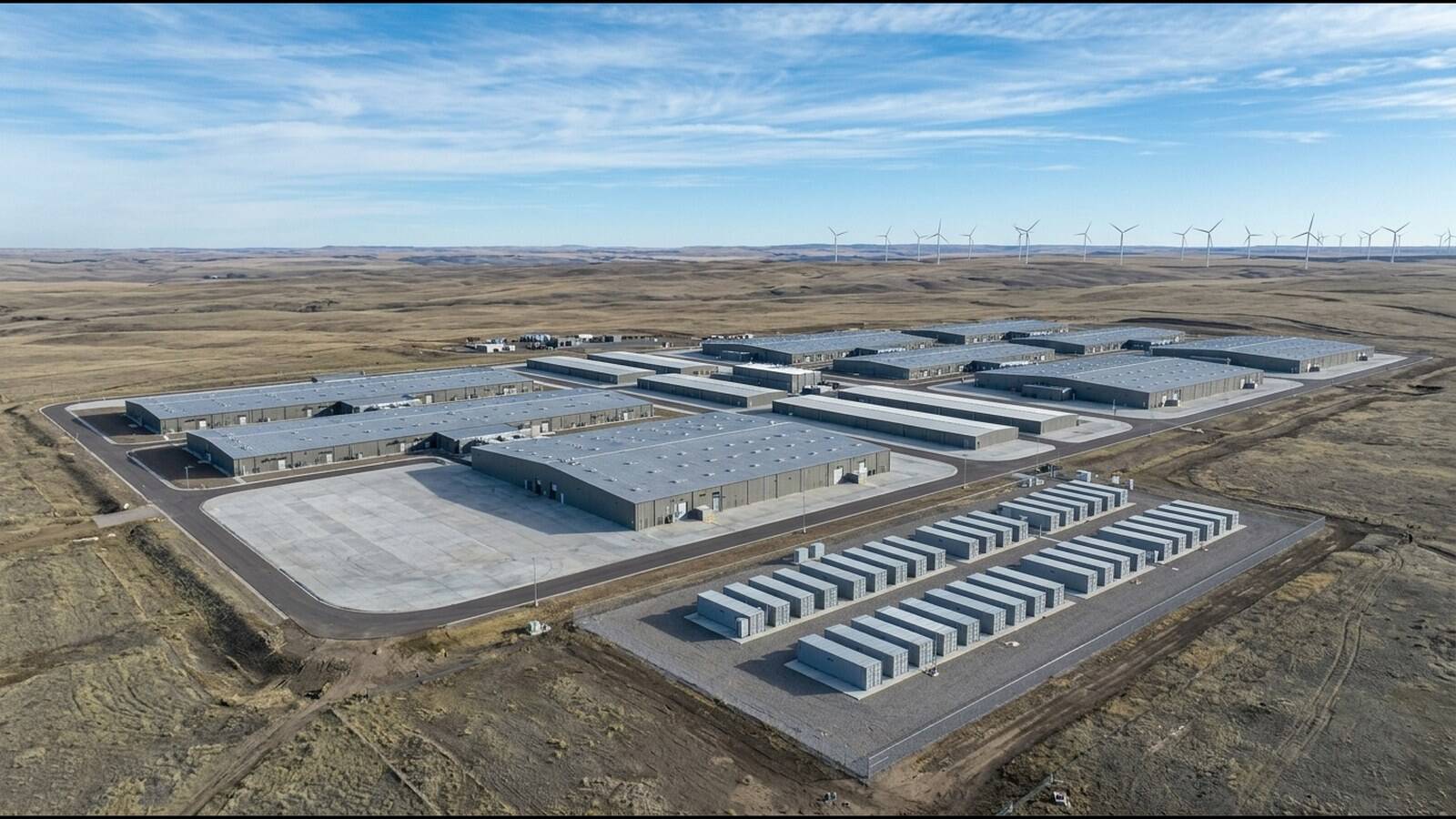
An Inner Mongolia data center campus called Galaxy brought its first 120MW phase online within a year, at roughly a fifth of what a comparable US build would cost, according to a site visit report from SemiAnalysis published on November 7, 2026. The Ulanqab campus, owned by Envision Group, is planned for up to 800MW of IT capacity, putting it in the same league as OpenAI's Stargate site in Abilene, Texas.
The report, written by Everlyn Tan, Jeremie Eliahou Ontiveros, Xiaopeng Laoban and Dylan Patel, is mostly behind a paywall, but its public section lays out the key numbers. The cost comparison is the firm's own estimate, not an audited figure, and the two internet companies the campus is being built for are not named.
What is the Galaxy campus?
Galaxy is a four phase, built to suit campus for two unnamed internet giants. SemiAnalysis says the first phase was delivered in August 2026 and the full site is expected to be finished by the end of 2027. Envision, which SemiAnalysis describes as a renewable systems integrator with more than 100GW of wind turbines installed worldwide, has datacenter plans in Inner Mongolia adding up to 3GW. If a turbine blade factory next to the campus is converted later, Galaxy itself could grow to about 1GW.
Why is Inner Mongolia drawing AI data centers?
SemiAnalysis calls the region the "West Texas" of China and says it is the country's fastest growing AI datacenter region, with 25GW of announced projects lined up. The difference, the report argues, is public mood: Texas is seeing its strongest anti datacenter sentiment yet, while Inner Mongolia faces no such backlash. Cheap land and strong wind matter too, since the region holds about 57% of China's usable wind resources. We have seen a similar capacity race in Southeast Asia's data center boom.
How does Galaxy compare with Stargate Abilene?
Crusoe's Abilene campus, leased to Oracle and run for OpenAI, is described as 1.2GW of power, or about 820MW of critical IT capacity, close to Galaxy's planned 800MW. The power mix is the big contrast. Abilene leans on the grid and on gas turbines on site, while Galaxy relies largely on wind. US AI firms are increasingly buying their own generation, as seen in the Anthropic generator deal.
How does a wind powered campus keep running?
Envision aims to supply more than 60% of the first two phases' power from its own wind farms. Two farms sit about 80km apart, so it is rarely calm at both at once, and together they have 420MW of installed capacity, about 1.75 times the 240MW datacenter load. A dedicated power line links them to the campus, and a 4 hour battery system that Envision builds itself shifts energy from windy hours into calm ones. Ulanqab's wind farms run at a capacity factor of 35 to 40%.
What is new inside the halls?
In one 5MW hall, solid state transformers take 10kV AC from the grid and convert it straight to 800V DC for the racks. That removes the low voltage transformers, UPS units and rectifier stages in between, an architecture that is still only on the US roadmap. SemiAnalysis notes that about a quarter of Chinese datacenters built in the past decade already run on DC, while about 97% of US datacenters still use AC UPS. Cooling skips central chillers entirely and uses a shared water loop for both liquid and air cooled servers, helped by the cold climate.
The pilot is small at 5MW, so it is a signal rather than proof that 800V DC is ready at full scale. Still, the speed of the build shows that power and construction, not just chips, are where AI infrastructure competition is now playing out, much like the Crusoe Wyoming project in the US.
| Item | Galaxy, Inner Mongolia |
|---|---|
| Owner | Envision Group |
| Planned IT capacity | Up to 800MW |
| First phase | 120MW, delivered August 2026 |
| Estimated cost | About a fifth of US costs (SemiAnalysis estimate) |
| Power | Over 60% wind target, 420MW farms, 4 hour batteries |
| Completion | End of 2027 |