
Leonid Meteor Shower 2026: Peak Night and Best Time to Watch
The Leonid meteor shower 2026 peaks November 16-17 with a 39% Moon. Here is the best time to watch, where to look, and the Mars and Jupiter pairing.
 Hakkı ALKAN
Published 4 min read
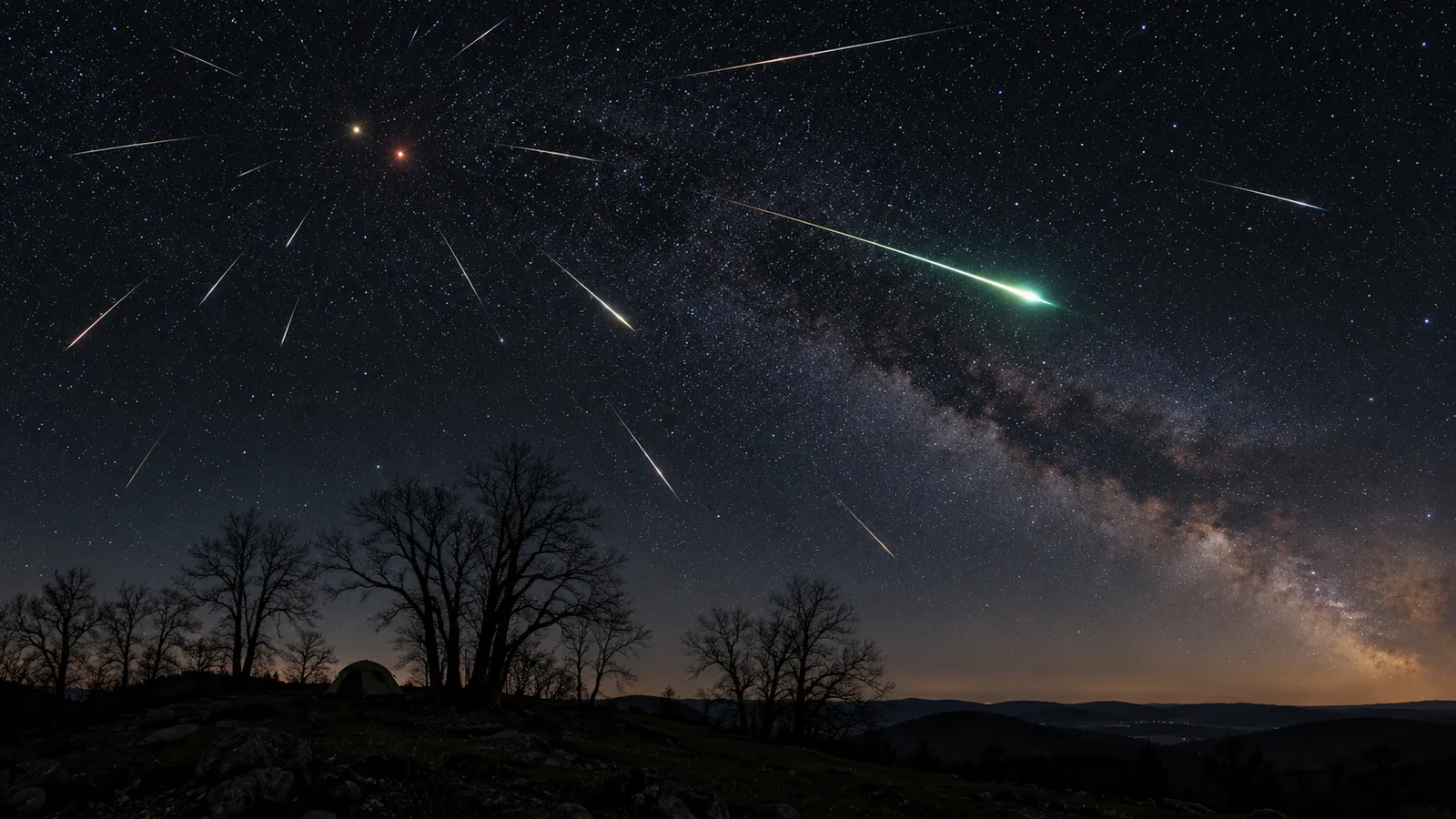
The Leonid meteor shower 2026 peaks on the night of November 16-17, according to the American Meteor Society (AMS). The shower is active from November 6 to 30, and this year the timing is kind to skywatchers: the Moon is a 39% lit waxing crescent on peak night and sets before the meteors’ radiant climbs high, so the best hours before dawn should be dark.
November also brings a close pairing of Mars and Jupiter in the same patch of sky as the Leonid radiant, plus a good morning view of Mercury. Here is what to expect and when to look.
When Is the Leonid Meteor Shower 2026 Peak?
The AMS lists the peak night as November 16-17, 2026, with activity running from November 6 to November 30. Its 2026/2027 meteor shower calendar rates the lunar conditions on peak night as favorable, with the Moon only 39% illuminated.
Meteor showers do not switch off after the peak, so the nights of November 15-16 and November 17-18 are worth a try too. On November 17 the Moon reaches first quarter, which means a little more moonlight in the evening, but it still sets around midnight for most of the Northern Hemisphere.
How Many Leonids Will You See?
Do not expect a storm this year. NASA says Leonid rates are often as low as about three meteors per hour, although the shower is known for bright, colorful meteors, fireballs and long “Earth-grazers” that skim near the horizon. Russia’s Ural Federal University educational observatory has forecast up to 20 meteors per hour at the peak, and says that figure is only an estimate.
Leonid meteors are among the fastest of any annual shower. They hit the atmosphere at about 44 miles (71 kilometers) per second, according to NASA’s Leonids guide.
Best Time and Where to Look
The meteors seem to come from the constellation Leo, which rises in the east around 11 p.m. local time from mid-northern latitudes. Using standard orbital data for New York, the Moon sets at about 10:50 p.m. on November 16 and close to midnight on November 17. The best window is therefore from about 1 a.m. until the first light of dawn, when Leo is high and the sky is dark.
- Get away from city lights and give your eyes about 30 minutes to adjust to the dark.
- Lie on your back with your feet toward the east and look up at a wide area of sky, not only at Leo.
- Dress for winter temperatures; mid-November nights can be cold.
- Skip the telescope or binoculars. Meteors cross large parts of the sky, so your eyes work best.
Why the Leonids Sometimes Turn Into Storms
The Leonids come from dust shed by comet 55P/Tempel-Tuttle, which orbits the Sun every 33 years. When Earth crosses a dense, older trail of that dust, rates can jump to thousands per hour, as in 1833, 1866 and 1966. NASA defines a meteor storm as at least 1,000 meteors per hour; the last Leonid storm came in 2002.
The AMS says Earth is not expected to hit another dense debris cloud until 2099. When the comet returns in 2031 and 2064, there may be good displays with more than 100 meteors per hour, but probably no storms. Space rocks that survive the trip to the ground are rarer still, like the 4.1 billion year old Mars meteorite scientists described this week.
Mars and Jupiter Meet Near the Leonid Radiant
If you go out for the Leonids, look for two bright “stars” in Leo. Bright, yellowish Jupiter and fainter, reddish Mars draw closer through the first half of November and are only about 1.2 degrees apart around November 16, less than one finger width at arm’s length. Both rise in the east around 11 p.m. and climb high before dawn.
The Moon also passes close to Jupiter on the night of November 2-3 and returns near the pair on November 30 and December 1. After mid-month, Mars and Jupiter slowly drift apart again.
Other Sky Events in November 2026
- Southern Taurids: peak November 4-5, a slow shower rich in fireballs, with the Moon 25% lit.
- Northern Taurids: peak November 11-12, two days after the November 9 new moon, so skies will be very dark.
- Mercury: reaches its greatest western elongation on November 21, about 19.6 degrees from the Sun, making it easiest to spot low in the east before sunrise.
- Full moon: November 24, which will wash out fainter meteors in the last week of the month.
If you want more space news after a night outside, read our guide to the Artemis 3 launch date or the plan to save the Hubble Space Telescope.