
Sunwoda Solid-State Battery Survives 200°C Heat Test Without Fire
Sunwoda solid-state battery: the 20 Ah Xin Bixiao cell passed a 200°C hot-box test with 400 Wh/kg and 1,200+ cycles, now in carmaker testing.
 Hakkı ALKAN
Published 2 min read
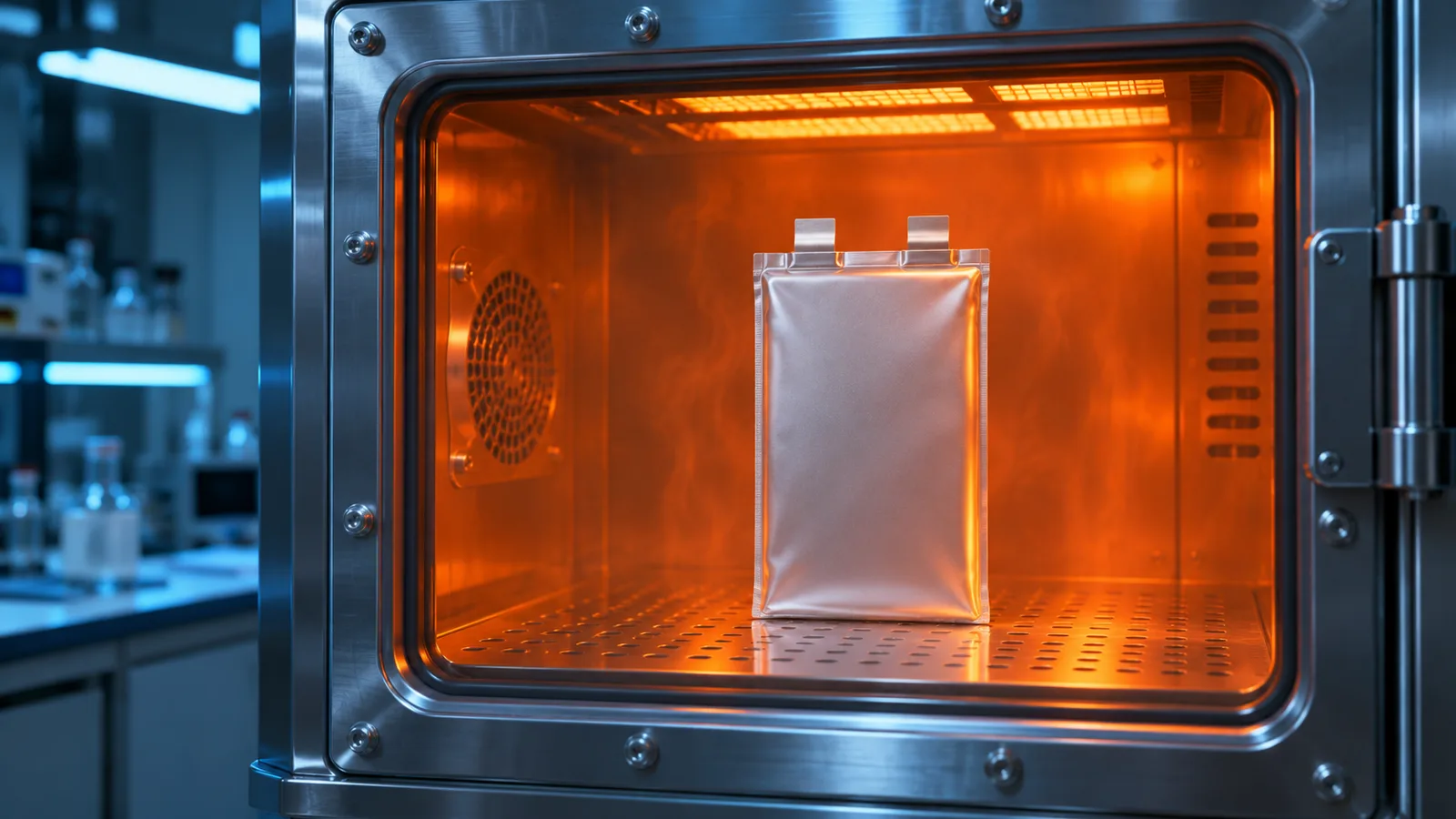
Chinese battery maker Sunwoda says its 20 Ah Xin Bixiao solid-state cell did not catch fire or explode when heated to 200°C (392°F) in a hot-box safety test. The Sunwoda solid-state battery also reaches more than 400 Wh/kg and over 1,200 charge cycles, figures the company links to electric cars with a range above 1,000 km (about 620 miles).
The update came from Sunwoda Electric Vehicle Battery (SEVB), the group’s automotive unit, in an October 30 reply on the Shenzhen Stock Exchange investor platform. SEVB said the cell has completed design and process verification and is still being evaluated by carmakers, which it did not name. As CarNewsChina notes, customer testing first started in May 2026.
How the Sunwoda Solid-State Battery Is Built
Xin Bixiao uses a polymer-composite electrolyte instead of the sulfide chemistry that rivals such as CATL are pursuing. The cell combines a 12-micron polymer-composite membrane with a nanoscale high-entropy silicon anode, and Sunwoda says it reaches its cycle life at an external pressure below 1 MPa.
That low pressure matters. Solid electrolytes can lose contact with the electrodes as materials swell and shrink during charging, so some sulfide designs need constant clamping force inside the pack. Sulfide materials also react with moisture and can release toxic hydrogen sulfide, which makes factories harder to run.
After 1,200 cycles the cell keeps more than 80% of its original capacity. Sunwoda estimates that would cover more than a decade of use for a driver who covers about 20,000 km (12,400 miles) a year.
Results Are for One Cell, Not a Car
The important caveat is scale. The heat, energy density and lifespan figures come from a single cell, not a full battery pack installed in a vehicle, and Interesting Engineering points out that the company has not committed to a launch date for its high-density cells.
Earlier lab results, such as a NASA solid-state battery built for extreme cold, show how long the path from cell to product can be.
Production is also small for now. SEVB has connected a pilot line with an annual design capacity of 0.2 GWh, enough for roughly 2,600 to 2,700 electric cars a year. Its roadmap lists a second-generation sulfide battery for 2027 and a cell above 500 Wh/kg for 2030, both still development targets.
What It Means for the EV Battery Race
CATL, the world’s largest EV battery maker, reaffirmed on October 27 that it aims for small-batch production of sulfide solid-state cells in 2027. Sunwoda’s polymer route gives carmakers a second option, at a time when many Chinese automakers are losing money and looking for any edge on range and safety.
Sunwoda is also working on cells of at least 450 Wh/kg for electric aircraft (eVTOL) that can deliver 1,000 W/kg of continuous power, alongside a fast-charging LFP pack that goes from 10% to 70% in about five minutes. Other chemistries are moving too, including a sodium metal battery that keeps 90% capacity after 1,000 cycles. For buyers, solid-state cars with these specs are still years away, but the safety data is a step in the right direction.