arkadaşlar ayrı ayrı 2 metin verecem size ve bugün içerisinde bu metinlerin türkçesi lazım bana ve mutlaka bugün içerisinde olmalı lütfen yardımcı olun 2 saattir uğraşıyorum bir türlü toparlayamıyorum cümleleri.
"The
Winogradsky column is a simple device for culturing a large diversity of
microorganisms. Invented by
Sergei Winogradsky, the device is a column of pond mud and water mixed with a carbon source such as newspaper (containing
cellulose) blackened marshmallows or egg-shells (containing
calcium carbonate) and a
sulfur source such as gypsum (
calcium sulfate) or egg-yolk. Incubating the column in sunlight for months results in an
aerobic/
anaerobic gradient as well as a sulfide gradient. These two gradients promote the growth of different micro-organisms such as
clostridium,
desulfovibrio,
chlorobium,
chromatium,
rhodomicrobium,
beggiatoa, as well as many other species of bacteria, cyanobacteria, and algae.
The column provides numerous gradients, depending on additive nutrients, from which the variety of aforementioned organisms can grow. The aerobic water phase and anaerobic mud or soil phase are one such distinction. Due to low oxygen solubility in water the water quickly becomes
anoxic towards the interface of the mud and water. Anaerobic phototrophs are still present to a large extent in the mud phase, there is still capacity for biofilm creation and colony expansion, as noted by the images. Algae and other aerobic phototrophs are present along the surface and water of the upper half of the columns. Green growth is often attributed to these organisms.
ConstructionThe column is a rough mixture of ingredients - exact measurements are not critical. A tall glass or plastic tube (30cm long, >5cm wide) is filled one third full of pond mud, omitting any sticks, debris, air bubbles. Supplementation of ~0.25% w/w calcium carbonate and ~0.50% w/w calcium sulfate or sodium sulfate is required. Mixed in with some shredded newspaper or hay (for cellulose), ground egg-shell and egg yolk respectively are rich in these minerals. An additional anaerobic layer, this time of un-supplemented mud, brings the container to two thirds full. This is followed by water from the pond to saturate the mud and occupy half the remaining volume. The column is sealed tightly to prevent evaporation of water and incubated for several months in strong natural light."
2. metin
"Using Winogradsky columns, a soil enrichment culture, students explore microbial diversity through metagenomics.
The Winogradsky column is a complex community of interacting microorganisms. In a community such as is present in soil, we know there is an abundance of bacteria but we don't really know the true extent of the diversity and composition of the microbial community. Culture based-techniques are limited to analysis of the bacteria that grow in the lab, and most bacteria don't grow under normal lab conditions. Therefore, we need non-culture based techniques to investigate the diversity of this community. In this module, students investigate the microbial diversity in distinct layers of the Winogradsky column using high throughput sequencing of 16s rRNA sequences. Students extract genomic DNA from the Winogradsky column, the 16s rRNA genes are amplified by PCR, and the products are sequenced. The obtained sequences are then classified and analyzed using bioinformatics tools, and metabolic activities in the different regions of the columns are inferred from the species present.
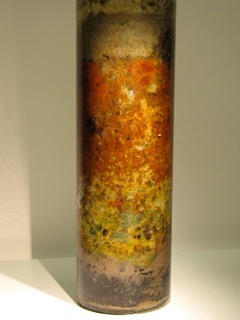
To make a Winogradsky column, mud is collected from a pond or riverbank and added to a plexiglass cylinder along with a source of cellulose, such as leaf litter, and additional sulfate to promote enrichment for microorganisms involved in the sulfur cycle. Over a period of months, layers of microorganisms requiring a range of environmental conditions develop in distinct niches with distinct populations participating in diverse metabolic activities. As various metabolites in the column are used, byproducts are produced, and the environment in the column changes. As a result of changing concentrations of oxygen, hydrogen sulfide, and variations in other metabolites, different microbes will thrive in their own niche. Bacterial growth is seen as changes in color from the original grey-brown mud to a rich pallet of reds and greens. The colored zones are due primarily to phototrophic microbes. In the upper, aerobic layers, we can expect photosynthetic eukaryotic microbes; in the lower, anoxic layers, we can expect purple and green, phototrophic bacteria. These phototrophic bacteria utilize various sulfur sources as electron donors for photolysis. The vast majority of these microorganisms cannot be cultured independently under normal laboratory conditions."