
How Do Undersea Cables Work? Lasers, Glass and Repairs
Undersea cables carry almost all international internet traffic with lasers and hair-thin glass fibers. Here is how they work, who owns them and how they break.
 Hakkı ALKAN
Published 3 min read
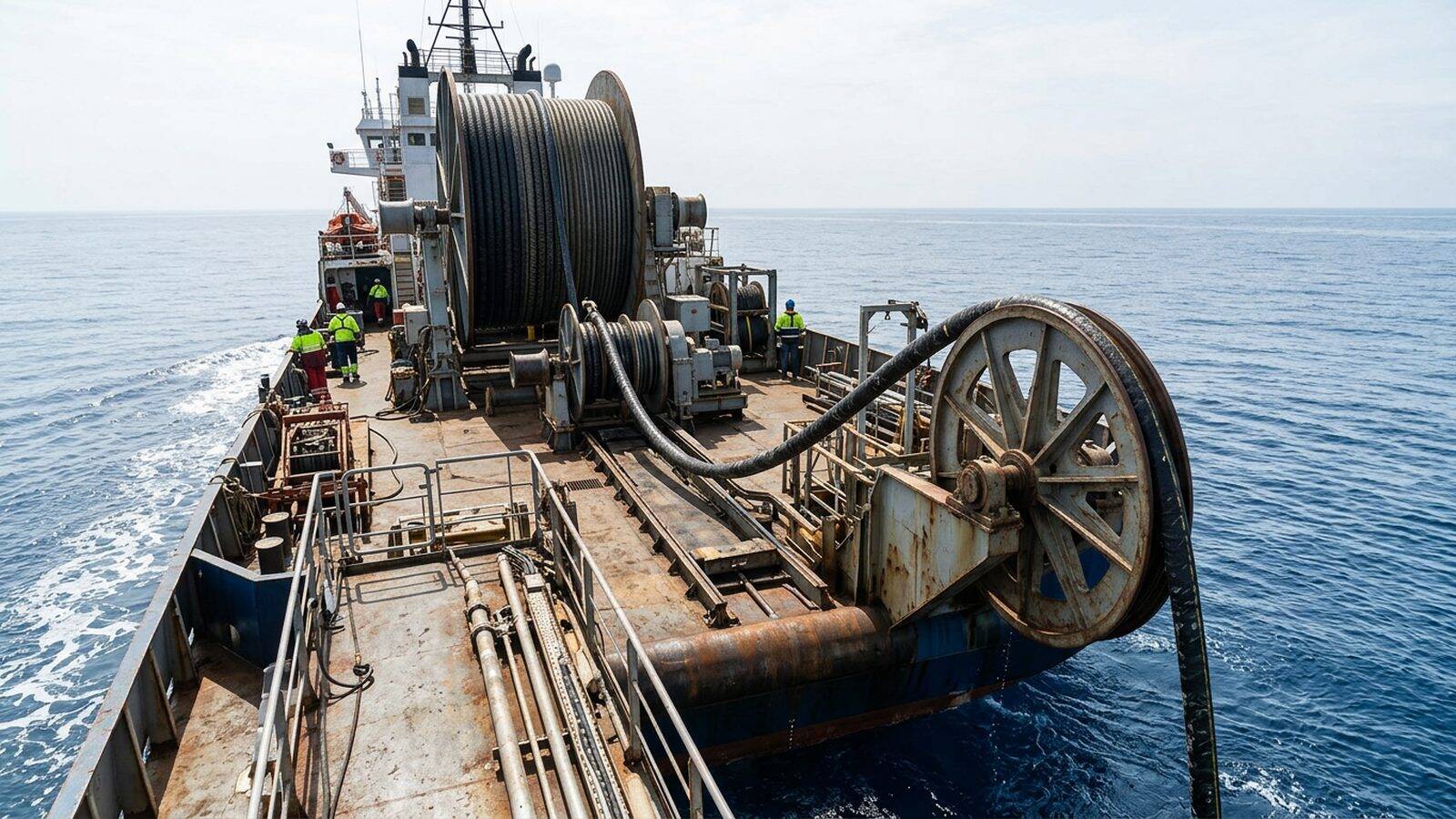
Undersea cables work by firing laser light through hair-thin glass fibers laid on the ocean floor, carrying data between continents at the speed of light in glass. They move almost all international internet traffic, and they are back in the news after Iran-linked ships were tracked loitering over the Hormuz undersea cables in October.
How do undersea cables work inside?
A laser at one end of the cable switches on and off at extremely high rates, and a receiver at the other end reads those pulses as data. The glass fibers that carry the light are roughly as thin as a human hair. Several pairs of them sit at the core, wrapped in layers of plastic and, closer to shore, steel wire for protection.
In the deep ocean, a typical cable is only about as wide as a garden hose and rests directly on the seabed. Near the coast, where anchors and trawlers are a bigger risk, it gets extra armor and is buried under the sea floor. That is why you never see one at the beach.
How many undersea cables are there?
According to TeleGeography's submarine cable FAQ, the research firm tracks more than 600 active and planned systems as of 2026. Together they add up to over 1.5 million kilometers of cable in service.
| Fact | Figure |
|---|---|
| Active and planned cables tracked | 600+ |
| Cable length in service | Over 1.5 million km |
| Short example: CeltixConnect (Ireland to UK) | 131 km |
| Long example: Asia America Gateway | 20,000 km |
| MAREA potential capacity | 224 Tbps |
| Faults per year (ICPC average) | About 200 |
| Minimum design life | 25 years |
Who owns the cables?
Telecom carriers traditionally built cables together as consortiums and shared the capacity. That model still exists, but the biggest new investors are now content companies such as Google, Meta, Microsoft and Amazon. Their traffic between data centers grows so fast that owning the fiber outright makes more sense than renting it.
Why not just use satellites?
Satellites are great for reaching places fiber does not, but fiber carries far more data for a fraction of the cost. US Federal Communications Commission figures cited by TeleGeography put satellites at just 0.37% of all US international capacity. Even services like Starlink end up handing traffic to fiber on the ground. Your phone is only wireless as far as the nearest cell tower, and after that your data rides on cables.
What happens when an undersea cable breaks?
Breaks are routine. The International Cable Protection Committee counts roughly 200 faults a year, and about two-thirds come from fishing vessels and ships dragging anchors. Earthquakes and failed components cause most of the rest, while deliberate sabotage and shark bites are very rare.
Most users never notice a fault because networks spread their capacity across several cables. When one goes down, traffic shifts to the others while a repair ship hauls up the damaged section and splices in new fiber. Trouble starts when many cables share one narrow corridor, as they do in the Red Sea or the Strait of Hormuz.
Our Take
Undersea cables are some of the most important and least visible infrastructure on the planet. The engineering is remarkably simple, light in glass, but the real weakness is geography. Countries with only a handful of routes, especially those that depend on a single strait, have the most to lose, so new cables that add diverse paths matter as much as faster ones.